| Specification | Value |
| Operating frequency, ± 1% | 159.2 Hz |
| Acceleration output, ± 3% | 1.0 g (9.81 m/s2), RMS or Peak |
| Velocity output | 0.39 ips (9.8 mm/s), RMS or Peak |
| Displacement output | 0.39 mils (9.8 μm), RMS or Peak |
| Transverse amplitude | ≤ 3% |
| Mounting thread | 1/4-28 female |
| Mounting torque, max | 10 in-lb (112 N-cm) |
| Maximum load | 250 grams; ballast mass required if load is <75 grams |
| Distortion, 0-250 gram load | ≤ 7% |
| Power supply | 4x AA batteries, included, or optional AC power supply (12 VDC ± 5%, 1.67 A, center positive) |
| Operating cycles on battery power | 80 tests at 250 gram load |
| Automatic switch off time | approx 80 seconds |
| Ramp-up time | ≤ 3 sec |
| Temperature range | +15° to +130°F (–10° to +55°C) |
| Shaker dimensions | diameter: 2.2 in. (5.6 cm)
height: 7.8 in. (19.8 cm) |
| Weight, with batteries | 900 grams (32 oz) |
| Case material | 6061-T6 aluminum |
| Included accessories | 1/4-28 mounting stud, M6 mounting adapter stud, 10-32 mounting adapter stud, REF004 ballast mass, canvas sleeve, 4 AA batteries |
| Optional accessories | REF001 universal mounting kit, REF002 metric mounting kit, TAA01 triaxial accelerometer angled adaptor, REF005 AC power supply |
How do you verify a vibration sensor in the field?
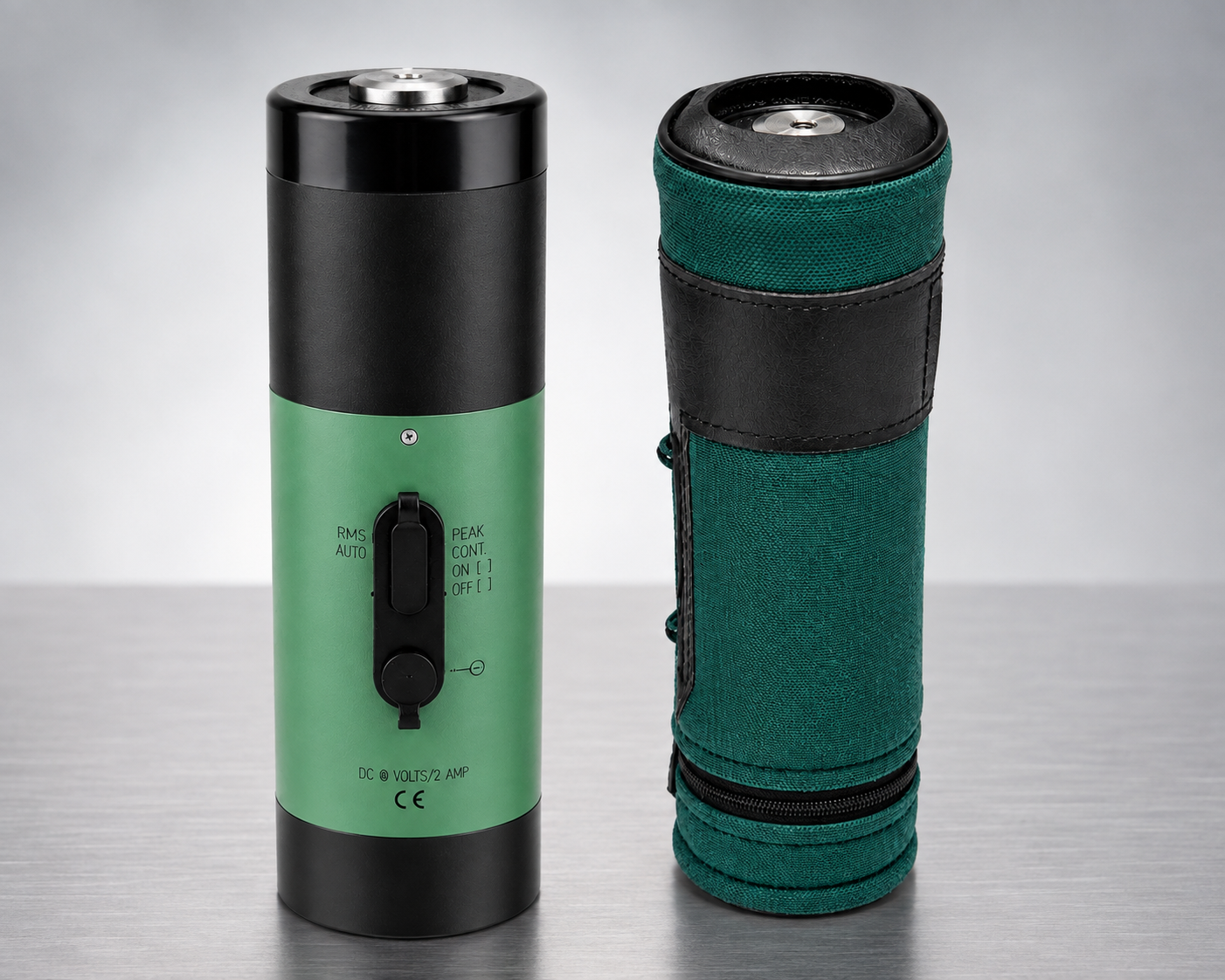
The REF1500 applies a known mechanical vibration of 1 g at 159.2 Hz directly to the sensor. Because the vibration input is known, the expected sensor response can be determined from the sensor’s sensitivity or configured output range.
The resulting signal can then be observed at the sensor output or through the connected measurement system. If the measured value corresponds to the known input, the test provides confidence that the sensor, cabling and connected equipment are functioning together as expected. If it does not, the known input provides a starting point for troubleshooting where the discrepancy occurs in the measurement chain.
For example, a 100 mV/g accelerometer subjected to the REF1500’s 1 g vibration should produce approximately 100 mV. If the sensor, cabling and data acquisition system are functioning and configured correctly, the system should interpret and display that input as 1 g. A 4–20 mA vibration sensor with a 5 g full-scale range should output approximately 7.2 mA at the same 1 g input.
If the measured value does not match the expected response, the known input provides a reference for troubleshooting. The sensor, cabling and connected measurement equipment can then be checked to isolate the source of the discrepancy and determine whether the problem is with the sensor or elsewhere in the measurement chain. Performing this test in the field can help avoid unnecessarily removing, replacing or sending out a sensor when the problem lies elsewhere in the system.
Does the REF1500 calibrate vibration sensors?
The REF1500 is intended for functional verification, not as a replacement for laboratory calibration. It applies a known vibration reference that allows users to confirm that a sensor and connected measurement chain are producing the expected response.
Why does the REF1500 operate at 159.2 Hz?
At 159.2 Hz, a 1 g acceleration corresponds to approximately 9.8 m/s2 acceleration, 9.8 mm/s velocity and 9.8 um displacement, providing convenient metric/SI vibration reference values.
What sensors can be tested?
The REF1500 is intended to be used with accelerometers, piezovelocity sensors and displacement sensors, including 4–20 mA models. The combined sensor and mounting load can be up to 250 grams.
Included and optional mounting accessories make the handheld shaker compatible with a wide range of vibration sensors.
What if my sensor weighs less than 75 grams?
Use the included REF004 ballast mass between the sensor and shaker head. The REF1500 requires the ballast mass when the sensor system weighs less than 75 grams.
Can triaxial accelerometers be tested?
Yes. The optional TAA01 angled adapter is designed to excite all three axes of the 993B-7-M12 simultaneously. The resulting vibration is approximately 0.57 g per axis.
Can I verify sensors with captive-screw mounting?
Yes. Sensors with a captive 1/4-28 can be screwed directly into the shaker head. Optional adapter plates allow the REF1500 to accommodate sensors with metric captive-screw threading.
What happens if the REF1500 cannot maintain 1 g?
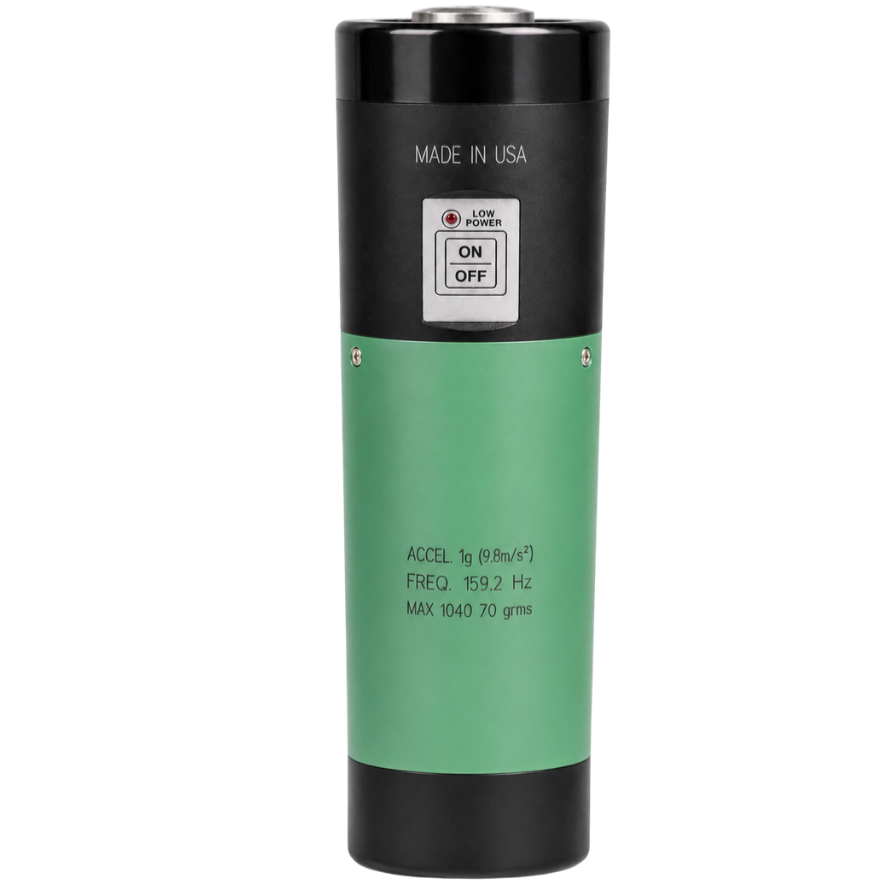
The REF1500 monitors its ability to maintain the required 1 g vibration with a built-in accelerometer. An LED above the ON/OFF switch indicates when the unit is approaching an inability to drive the mass on the shaker due to a test sensor that is too heavy, low battery power or an inadequate external power supply. The indicator does not signify erroneous data. If the REF1500 can no longer generate 1 g, the unit shuts off.
Why do I have to wait three seconds before taking a reading?
The REF1500 gradually ramps up to the controlled vibration level over approximately three seconds. This smooth turn-on helps prevent shock-induced overloads to the test sensor.
How can I check that the REF1500 itself is operating correctly?
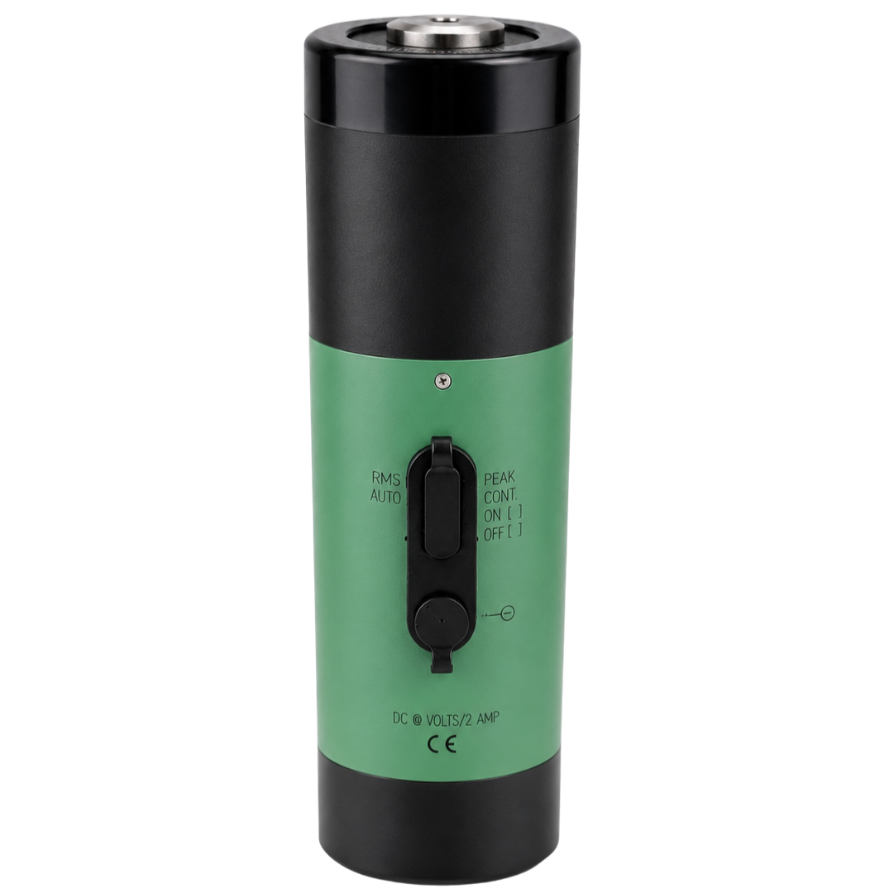
Built-in test points allow the internal feedback circuit to be compared with the values on the calibration certificate. This provides a quick field integrity check when a reference standard is not available, such as after the unit has been dropped. It is not a substitute for calibration; if the values do not agree, the REF1500 should be checked against an appropriate calibration standard.
What can a portable vibration reference source be used for?
Installation verification
Verify that a newly installed vibration sensor and its connected measurement chain are functioning correctly before placing the measurement point into service.
Measurement-chain verification and troubleshooting
Verify signal integrity through the cabling between the vibration sensor and the connected data acquisition or online monitoring system.
Sensor functional verification
Quickly confirm that an accelerometer, piezovelocity sensor or displacement sensor responds to a known vibration input in the field.
Condition monitoring system checks
Use a known mechanical vibration input to confirm that vibration measurements are reaching the equipment used to monitor machine condition.
4–20 mA vibration transmitter sensors
Verify sensor operation and scaled output through the measurement chain, including configured full-scale ranges and alarm or trip setpoints in PLCs, DCSs and SCADA systems.
 EN
EN ENGLISH