Following our recent webinar, Digital Accelerometers vs. Converters: Selecting the Right Path to Reliable Vibration Data, we received several questions about triaxial accelerometers.
During the webinar, Tom LaRocque and Peter Eitnier discussed how digital accelerometers can offer a cost advantage for general-purpose monitoring, especially when triaxial measurements are needed and the available protocols align with the system architecture. They also discussed where piezoelectric accelerometers remain the better fit, including applications requiring wider frequency response, more demanding environmental requirements, or greater architecture flexibility.
This follow-up addresses the questions participants submitted about triaxial accelerometers.
▶ Steam the webinar on demand on CBM Connect
Webinar Q&A
What are triaxial accelerometers?
A three-axis accelerometer, called a triaxial accelerometer, measures vibration simultaneously in three orthogonal axes (X, Y, and Z). Depending on the installation, these axes are often aligned with the machine's horizontal, vertical, and axial directions. Instead of requiring three separate sensors and cables, a triaxial accelerometer combines three sensing elements into a single device.
Are triaxial accelerometers based on piezoelectric or MEMS technology?
Triaxial accelerometers are available in both piezoelectric and MEMS technologies. The term triaxial describes the number of measurement axes, while piezoelectric and MEMS describe the sensing element used inside the accelerometer. Wilcoxon offers both piezoelectric and MEMS triaxial accelerometers.
The choice between piezoelectric and MEMS depends on the application's performance, environmental, and connectivity requirements. Digital MEMS accelerometers can offer a cost advantage for general-purpose condition monitoring applications in mild factory environments when their communication protocols align with the monitoring system. Piezoelectric accelerometers are typically preferred for applications requiring wider frequency response, higher temperature ratings, harsh environments, or hazardous-area certifications.
As discussed in our webinar, the decision is about selecting the sensing technology that best matches the application's requirements.
MEMS triaxial accelerometers are often a good fit when:
- General-purpose condition monitoring is the primary objective
- A frequency response of approximately 2 Hz to 5 kHz is sufficient
- Operating temperatures are typically between -20°C and +85°C
- Standard industrial environmental protection ratings such as IP65 or IP67 meet the application's needs
- Direct integration with Modbus or IO-Link digital communication protocols is desired
Piezoelectric triaxial accelerometers are often a good fit when:
- Wider frequency response is required, up to 10 kHz or higher
- High-temperature operation is required, up to +120°C or higher
- Hazardous-area certifications (such as Class I, Div 1 or ATEX), submersible ratings (IP68 or deep underwater), or other specialized environmental protections are needed
- Maximum flexibility in digital protocol and monitoring architecture is required
Are triaxial accelerometers easily connected to digital converters?
Yes. Triaxial piezoelectric accelerometers with IEPE signal conditioning can be connected to digital converters just like single-axis IEPE accelerometers. Each axis produces its own vibration signal, which is connected to a separate converter input channel.
This approach combines the benefits of triaxial vibration data with the protocol flexibility of a converter-based architecture. Rather than being limited to the communication protocols available from a particular digital sensor (typically Modbus or IO-Link), users can select a triaxial IEPE accelerometer based on performance and environmental requirements, then use a digital converter to deliver vibration data to the desired destination.
Wilcoxon offers digital converters with Modbus, OPC UA, and MQTT outputs, making it possible to integrate vibration data into existing control systems, enterprise applications, or cloud-based analytics platforms.
Do I actually need three axes of vibration data?
Not always. Many successful vibration monitoring programs rely on single-axis measurements because they provide sufficient information for the application. In many cases, reliability teams have established measurement locations, alarm thresholds, and diagnostic procedures built around a single measurement direction.
A single-axis accelerometer can detect many common machine faults. For example:
- Misalignment often produces significant axial vibration.
- Structural looseness may appear more strongly in one radial direction.
- Resonance issues can be highly directional.
When the expected vibration behavior is understood and the sensor is installed in the appropriate location and orientation, a single-axis measurement is often sufficient to detect and trend these conditions.
Triaxial accelerometers become valuable when the optimal measurement direction is unknown or when vibration behavior may change over time. Triaxial data can also provide additional value when mounting locations are limited, or for convenience with walkaround, or portable, data collection. If only one practical measurement point is available, collecting vibration data in three directions can help maximize the information obtained.
Are triaxial accelerometers better for route-based collection than for permanent monitoring?
Historically, triaxial accelerometers were used to improve the efficiency of route-based data collection. Instead of repositioning a single-axis sensor to collect horizontal, vertical, and axial measurements, technicians could capture all three directions simultaneously from a single mounting location. This reduced collection time, improved measurement consistency, and simplified route-based vibration programs.
In modern advanced analytics applications, triaxial vibration data is increasingly attractive for permanent installations. Machine learning, digital twins, and other AI-driven approaches often benefit from richer datasets. While more data does not automatically produce better results, access to vibration information from all three axes can provide additional context for automated diagnostics, anomaly detection, and future analysis techniques.
Triaxial accelerometers provide three times as much data. Do I need to store all three axes? If not, which axis should I trend?
True, triaxial accelerometers provide three times as many vibration measurements as a single-axis sensor. While modern monitoring systems can collect, store, and analyze large amounts of data, not every parameter needs to be continuously polled, stored, trended, and alarmed.
Reliability teams need to decide which measurements provide the most value. Some organizations trend a single axis and retain the others for diagnostics. Others trend all three axes when storage, bandwidth, and analytics justify the additional data. The right approach depends on the application's objectives, the equipment being monitored, the monitoring architecture itself, and the organization's data management strategy.
If only a single axis is trended, a common practice is to select the axis with the highest or most repeatable vibration response. However, there is no universal "best" axis. The preferred measurement direction depends on the machine type, mounting location, and fault modes being monitored. For more detailed guidance on how mounting location and sensor orientation influence vibration measurements—and how those factors can help determine which axis provides the most meaningful data—download Technical Note 25, Measurement Locations and Considerations for Vibration Monitoring Sensors.
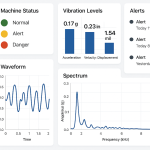
Modern digital communication protocols can also help balance data availability with practical data management requirements. For example, our 883M Digital Triaxial Accelerometer and Temperature Sensor provides vibration measurements across three axes, including waveforms, spectra, and a broad set of calculated metrics—resulting in a substantial volume of data. Users can selectively poll and trend the measurements most relevant to their application while retaining access to a much richer dataset for diagnostics, troubleshooting, and fault analysis when needed.
Wilcoxon’s Triaxial Accelerometers
The following table compares Wilcoxon's triaxial accelerometer options to help identify the best fit for an application.
| Model | Sensing element | Sensitivity | Full scale | Frequency range, ±3 dB | Operating temp range | IP rating | Connector | Hazardous area
certifications |
| 883M | MEMS | 0.488 mg resolution | ±16 g, peak | 2 Hz - 5 kHz (X, Y & Z axes) | -20°C to +70°C | IP67 | 4-socket M8 | |
| 993B-7-33 | IEPE | 100 mV/g ±10% | 40 g, peak | 2 Hz - 7,000 Hz (X & Y axes)
2 Hz - 10,000 Hz (Z axis) | -50°C to +120°C | IP68 | Teflon integral cable | Intrinsically Safe, ATEX Zone 0/1 |
| 993B-7 | IEPE | 100 mV/g ±10% | 40 g, peak | 2 Hz - 7,000 Hz (X & Y axes)
2 Hz - 10,000 Hz (Z axis) | -50°C to +120°C | IP68 | Armored integral cable | |
| 993B-6 | IEPE | 50 mV/g ±10% | 80 g, peak | 2 Hz - 7,000 Hz (X & Y axes)
2 Hz - 10,000 Hz (Z axis) | -50°C to +120°C | IP68 | Armored integral cable | |
| 993B-5 | IEPE | 25 mV/g ±10% | 160 g, peak | 2 Hz - 7,000 Hz (X & Y axes)
2 Hz - 10,000 Hz (Z axis) | -50°C to +120°C | IP68 | Armored integral cable | |
| 993B-7-M12 | IEPE | 100 mV/g ±10% | 60 g, peak | 2 Hz - 7,000 Hz (X & Y axes)
2 Hz - 10,000 Hz (Z axis) | -50°C to +120°C | IP68 | 4-pin M12 | |
| 993B-7-M12[CERT] | IEPE | 100 mV/g ±10% | 60 g, peak | 2 Hz - 7,000 Hz (X & Y axes)
2 Hz - 10,000 Hz (Z axis) | -50°C to +120°C | IP68 | 4-pin M12 | Intrinsically Safe, ATEX Zone 0/1 |
| 993E with TEDS | IEPE (TEDS) | 100 mV/g ±20% | 80 g, peak | 2 Hz - 5,000 Hz (X & Y axes)
2 Hz - 7,000 Hz (Z axis) | -50°C to +120°C | IP68 | 4-pin M12 | |
 EN
EN ENGLISH