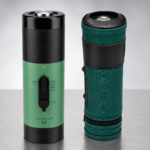
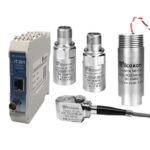
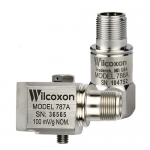
Test and Measurement (T&M) has long set the standard for accuracy, repeatability, and signal integrity in vibration analysis. From laboratory validation and structural dynamics to production testing and field trials, engineers rely on high quality analog instrumentation and sensitive piezoelectric accelerometers to capture data they can trust. As data consumption increasingly shifts toward cloud analytics, automation, and AI-driven workflows, the challenge is preserving test grade measurement data while making it digitally accessible. Wilcoxon's VDS100 Series, with options of MQTT and OPC UA digital vibration output, is designed to bridge that gap.
How Can Digital T&M Preserve Measurement Grade Signal Integrity?
The Vibration Data Source accepts high-resolution IEPE, AC coupled, and DC coupled accelerometer inputs and outputs high-fidelity vibration spectra and time waveforms consistent with traditional T&M instrumentation. This approach is especially important for low frequency applications, such as structural dynamics, balance, alignment, and modal testing, where digital sensor accuracy is often masked by noise. It is also effective for high frequency applications such as early-warning bearing fault analysis, resonance testing, and high speed machinery validation, where digital sensors may be limited to under 10 kHz.
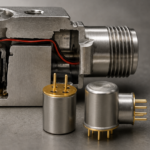
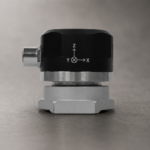
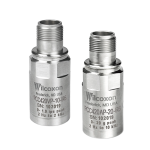
In these scenarios, many digital accelerometers exhibit elevated noise floors or limited low frequency performance that can obscure meaningful data. By conditioning proven analog piezoelectric accelerometer outputs, the VDS100 Series preserves ultra-low-noise signal quality, enabling engineers to work with the sensors and techniques they already trust. With an input sensitivity range of 1–1000 mV/g, the VDS is compatible with Wilcoxon’s high-sensitivity seismic accelerometers, preserving ultra-low-frequency, low-amplitude measurements down into the sub-µg range.
What T&M Applications Benefit from Digital Vibration Data?
The VDS100 Series is well suited for a variety of test and measurement use cases, including:
- Structural and modal testing, where accurate low frequency vibration data is critical for validating models and designs
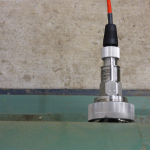
- Structural and infrastructure monitoring, supporting long-term analysis of large-scale assets like bridges, dams, tunnels, and geotechnical assets, where vibration is one of multiple inputs
- End of line and production testing, making vibration metrics and pass/fail indicators available to automated test, manufacturing, or quality systems
- Prototype and validation testing, enabling long duration data capture without manual data pulls
- Field trials and pilot installations, where test setups may later transition into continuous monitoring
By providing both processed vibration metrics and access to raw time waveform and spectral data, the VDS100 Series supports deep engineering analysis while remaining flexible enough for evolving test objectives.

How Can Vibration Data Connect to Modern T&M Systems?
Traditional T&M systems are often built around point to point data acquisition and manual data retrieval, but modern test data is increasingly used by automation, analytics, and other connected systems.
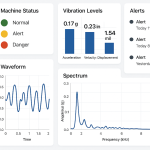
The VDS100 Series provides two digital paths for making vibration data available within these architectures. The VDS120 uses a built-in OPC UA server, making calculated values, time waveforms, and spectra available to OPC UA clients. This can support integrated and automated test benches, validation systems, structural and durability test setups, and production or end of line test environments. The VDS130 uses MQTT to publish vibration data in structured JSON format for consumption by databases, dashboards, cloud-based analytics tools, automation platforms, and other connected systems.
In both cases, the digital interface extends the reach of traditional vibration measurement rather than replacing classical T&M tools. The appropriate path depends on the infrastructure already used by the test environment and where the vibration data needs to go.
Bridging Traditional T&M and Digital Systems
For organizations seeking to modernize their measurement workflows without compromising data quality, the VDS100 Series offers Test & Measurement-grade vibration signals a practical path from the lab and test cell into connected digital systems, while preserving the measurement performance engineers expect from proven piezoelectric accelerometers.
 EN
EN ENGLISH