AI-enabled vibration monitoring is rapidly expanding across industrial facilities. Cloud analytics platforms such as Viking Analytics’ MultiViz platform, along with scalable predictive maintenance (PdM) and condition-based maintenance (CBM) strategies, allow reliability teams to monitor more assets with less manual review. However, extending AI-enabled vibration monitoring strategies into hazardous environments can be more challenging than in non-hazardous locations.
Hazardous locations are common across industries such as oil and gas, chemical processing, refining, mining, and energy production. These environments contain flammable gases, vapors, or combustible dust, requiring electrical equipment to be carefully designed and certified to prevent ignition. Integrating rotating assets in these zones into modern AI-enabled vibration monitoring architectures requires compatibility with hazardous location certified sensors.
What Makes Vibration Monitoring in Hazardous Areas Different?
Vibration sensors installed in hazardous locations must meet certification requirements designed to prevent electrical equipment from igniting a hazardous atmosphere. In the United States, common certifications include Class I Division 1 and Class I Division 2. Internationally, ATEX and IECEx certifications are widely used.
Intrinsically Safe (IS) vibration sensors are designed to limit electrical and thermal energy to levels that cannot ignite a hazardous atmosphere, even under fault conditions. These protections impose constraints on sensor electronics and power consumption, and as a result, the number of digital vibration sensing options currently available with hazardous-area certifications remains relatively limited.
Why Do Analog Vibration Sensors Still Dominate Hazardous Areas and Specialty Applications?
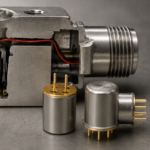
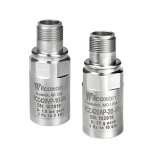
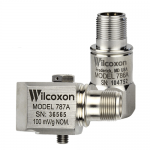
Analog piezoelectric accelerometers remain common in hazardous areas because they have well-established certification pathways and are available for specialty measurement requirements that remain relatively limited among digital sensors. Hazardous-area monitoring often overlaps with other demanding measurement scenarios, including:
- High temperature capability
- Rugged stainless-steel construction for corrosion resistance
- Ultra-low noise for low-frequency vibration measurements on slow-speed or structural assets
- Extended frequency range for gearbox and bearing diagnostics
How Can Analog Hazardous-Area Sensors Connect to AI Platforms?
Digital converters outside the hazardous area can digitize analog vibration signals from certified sensors in hazardous locations. This provides a practical way to integrate certified analog accelerometers into modern data pipelines.
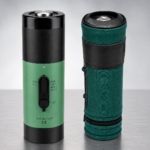
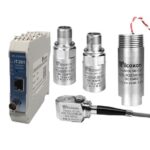
Wilcoxon's digital converters are helping to close this gap. The converter performs signal conversion and digital delivery outside of the hazardous environment to support modern AI and PdM workflows.
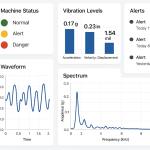
Converters can deliver vibration data using protocols such as MQTT, OPC UA, and Modbus. For example, Wilcoxon’s VDS130 MQTT vibration data source enables continuous delivery of vibration metrics, spectra, and waveforms into cloud analytics environments, with proven integration to the Viking Analytics MultiViz platform.
Read Part 2 on Viking Analytics: Applying AI-Accelerated Condition Monitoring in Hazardous Environments
Converting analog hazardous-area vibration data into modern analytics platforms is only the first step. In Part 2 of this series, Viking Analytics will examine how the MultiViz platform applies a hybrid AI that delivers behavior-based analytics, automatic prioritization, smart alarms, and automatic mode identification once this data becomes available.
Viking Analytics is also offering a free one-month MultiViz trial to users of Wilcoxon digital devices. Users can evaluate how behavior-based analytics turns vibration data into early warnings to help reduce unplanned downtime, prioritize what matters, and scale condition monitoring more efficiently.
 EN
 ENGLISH